


By Saleh Farouq Gagarawa, ANIPR
Ending leprosy in Nigeria will not be achieved by medicine alone. The sooner this is accepted, the sooner progress will move from being reported to being real.
For decades, the national response has rightly prioritised diagnosis and treatment. Yet the lived reality of those affected tells a different story—one where cure does not always translate into dignity, and survival does not guarantee inclusion.
The real gap is not clinical; it is structural. It lies in the policies that shape how people live after diagnosis, how early they seek care, and whether the system truly sees them at all.
At the heart of the problem is the absence of a strong, enforceable anti-stigma and anti-discrimination framework for persons affected by leprosy. Many still face exclusion in employment, education, housing, and even within healthcare settings. Without legal protection, stigma thrives quietly but powerfully—pushing people into silence and delaying care.
A rights-based legal approach would not only protect individuals; it would accelerate early detection by making it safer to come forward.
But dignity must go beyond protection—it must include economic recovery. Too many individuals complete treatment only to return to lives defined by poverty, unemployment, and dependency. Social reintegration and economic empowerment are not optional add-ons; they are essential public health strategies. 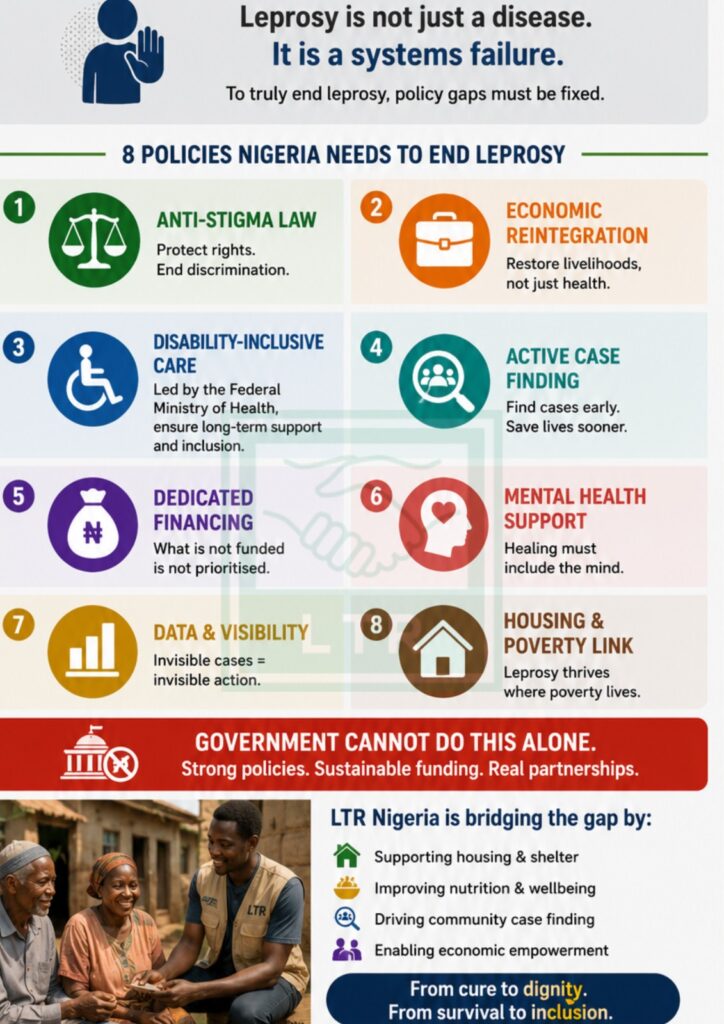
Skills development, micro-grants, and access to social protection systems enable people to rebuild their lives, regain confidence, and re-enter society with visibility and purpose.
This challenge is compounded by weak integration between leprosy services and disability systems. Leprosy often leads to long-term disability, yet many individuals fall through the cracks—no longer patients, but not fully supported.
A disability-inclusive policy framework, led by the Federal Ministry of Health, would ensure automatic linkage to rehabilitation, assistive services, and ongoing care, closing the gap between cure and quality of life.
Equally critical is how cases are detected. Nigeria still relies heavily on passive detection—waiting for individuals to present themselves at health facilities.
The consequences are predictable: delayed diagnosis, advanced disease, and continued transmission. A national shift toward early detection and active case-finding is urgently needed. Routine screening in high-burden areas, integration with primary healthcare and tuberculosis outreach, and incentivised community reporting can bring hidden cases to light.
Organisations such as Leprosy and Tuberculosis Relief Nigeria are already demonstrating what is possible—but without policy backing, these efforts remain fragmented and underfunded.
Funding itself is another constraint. Leprosy is often buried within broader disease budgets, making it difficult to prioritise or sustain. A dedicated financing and budget protection mechanism would ensure that resources are not only allocated but safeguarded, tracked, and aligned with measurable outcomes. Stronger domestic funding would also reduce dependence on external donors and reinforce national ownership.
Beyond the physical burden lies an often-neglected dimension: mental health. The psychological impact of leprosy—driven by stigma, isolation, and loss of identity—can endure long after treatment ends. Integrating mental health services into leprosy care is not optional; it is essential. Counselling, psychosocial support, and community-based interventions are critical to restoring not just health, but dignity and self-worth.
Even with these measures, progress will remain limited if affected individuals remain invisible in data. Weak data systems, limited disaggregation, and delayed reporting continue to obscure the true scale of the problem. Strengthening data visibility, transparency, and accountability would enable real-time tracking, better targeting of interventions, and stronger public oversight. When data is visible, priorities become clear—and when priorities are clear, action becomes measurable.
At its core, leprosy is not just a health issue—it is a development issue. It thrives in conditions of poor housing, malnutrition, and persistent poverty. Addressing it therefore requires a cross-sector approach that links health policy with housing, nutrition, and poverty reduction. Without this, the cycle will continue: people will be cured medically, only to return to the conditions that enabled the disease in the first place.
Government cannot do this alone. The scale and complexity of the challenge demand partnerships beyond traditional public health systems.
Organisations like Leprosy and Tuberculosis Relief Nigeria play a vital role—not as substitutes for government, but as strategic enablers. With strong community presence, technical expertise, and trusted relationships, they bridge the gap between policy and lived reality—particularly in addressing housing deficits, improving nutrition, and supporting economic recovery.
By integrating health interventions with social and economic support, such organisations demonstrate what a complete response looks like—one that does not end at cure, but continues until dignity is restored.
Ending leprosy in Nigeria will require more than commitment; it will require a shift in thinking—from treatment to transformation, from reactive systems to protective ones. The gaps are clear. The solutions are known. The opportunity is immediate.
What remains is the collective will to act—so that no one is cured and left behind.